

History of Capitol Hill Seattle: From Mansions to Pride, Protest, Music, and Modern City Life
Capitol Hill is not just one of Seattle’s most famous neighborhoods. It is the neighborhood where Seattle keeps reinventing itself in public.
You can see it in the old mansions near Volunteer Park, the brick auto-row buildings along Pike and Pine, the rainbow crosswalks near Broadway, the music venues, the apartment buildings, the co-ops, the condos, the pocket parks, the protest signs, and the late-night lines outside places that somehow feel both brand new and very old Seattle.
That is the magic of Capitol Hill.
It has been wealthy and scrappy. Catholic and queer. Residential and rowdy. Historic and constantly under construction. It has held some of Seattle’s grandest homes, its loudest nightlife, its most visible LGBTQ+ culture, and some of its most intense political moments.
If you are thinking about living in Capitol Hill Seattle, buying here, selling here, or just trying to understand why this neighborhood feels different from everywhere else in the city, the history explains a lot.
Capitol Hill did not become Capitol Hill by accident.
Before Capitol Hill Was Capitol Hill
Long before the neighborhood had its famous name, the ridge above downtown was rough land, timber, trails, and early city infrastructure.
In the late 1800s, the area was still being cleared and shaped as Seattle expanded uphill from downtown. Lake View Cemetery, now one of the neighborhood’s most historic places, became an early landmark on the ridge. Volunteer Park would later become one of the defining public spaces of the neighborhood.
Before the name “Capitol Hill” stuck, people often referred to the area as Broadway Hill.
That older name makes sense. Broadway became one of the central spines of the neighborhood, and it still plays that role today. Even now, if you are trying to understand Capitol Hill, you usually start with Broadway, then move outward toward Pike/Pine, 15th, 19th, Volunteer Park, Harvard-Belmont, Stevens, and the quieter residential streets tucked between them.
How Did Capitol Hill Seattle Get Its Name?
The name Capitol Hill came from real estate developer James A. Moore in the early 1900s.
And yes, there are two stories behind it.
The first story is ambitious in a very Seattle way. Moore reportedly hoped the Washington State Capitol might move from Olympia to Seattle. Calling the neighborhood “Capitol Hill” was a little bit of branding, a little bit of wishful thinking, and maybe a little bit of old-school developer confidence.
The second story is more personal. Moore’s wife was from Denver, which also had a Capitol Hill neighborhood. Some historians believe the Seattle name was partly a nod to her hometown.
Both stories can be true.
Either way, the name worked. “Broadway Hill” sounded practical. “Capitol Hill” sounded important. Moore was selling more than land. He was selling status, views, and the idea of a refined residential district above the growing city.
That early branding still echoes today. Capitol Hill may be far more eclectic now than Moore probably imagined, but the neighborhood has never stopped being one of Seattle’s most talked-about places to live.
The Rise of Millionaire’s Row
In the early 1900s, Capitol Hill became one of Seattle’s premier residential addresses.
Wealthy families built large homes near Volunteer Park, especially along 14th Avenue East. This stretch became known as Millionaire’s Row, and it still holds some of the neighborhood’s most beautiful historic homes.
Walk those streets today and you can still feel that older Capitol Hill.
The lots are larger. The homes have presence. The trees feel established. The streets are quieter than Broadway or Pike/Pine. There are grand old residences, historic apartment buildings, and architectural details that tell you this was once where Seattle’s early money wanted to be seen.
Volunteer Park helped anchor that identity.
Designed with influence from the Olmsted vision for Seattle parks, Volunteer Park became one of the city’s great public spaces. The conservatory, water tower, lawns, pathways, and views gave the neighborhood a formal green centerpiece.
That mix of grand homes and public green space is still a huge part of Capitol Hill’s appeal. Buyers who fall in love with North Capitol Hill, Harvard-Belmont, and the areas around Volunteer Park are often responding to that early 20th-century layer of the neighborhood, even if they do not know the full history yet.
Catholic Hill and the Neighborhood’s Institutional Roots
Capitol Hill was not only a wealthy residential district.
For much of the 20th century, parts of the neighborhood were closely tied to Catholic families, churches, and schools. The nickname “Catholic Hill” came from that history.
Institutions like St. Joseph’s Church and Holy Names Academy helped shape the neighborhood’s social fabric. These were not just buildings. They created routines, community networks, and a more settled residential identity in parts of Capitol Hill.
That is one reason the neighborhood still has such a layered feel.
Capitol Hill is not only nightlife. It is not only condos. It is not only old mansions. It is also schools, churches, apartment courtyards, long-time residents, old brick buildings, and quiet blocks where the city suddenly feels much softer.
That is what people miss when they only think of Capitol Hill as a nightlife district.
The neighborhood has always had multiple personalities at once.
Fred Anhalt and Capitol Hill’s Storybook Apartments
One of the best parts of Capitol Hill’s architectural history is the apartment buildings.
Fred Anhalt, one of Seattle’s most beloved apartment builders, left a major mark on the neighborhood. His Tudor-inspired brick buildings, courtyards, arches, leaded glass, and castle-like details are still some of the most charming residential spaces in the city.
These buildings matter because they show how Capitol Hill grew.
The neighborhood was not just built as a place for large single-family homes. It also became a place for elegant apartment living, smaller homes, rooming houses, co-ops, and later condos.
That variety is still one of Capitol Hill’s defining real estate traits.
You can find a historic mansion, a classic brick co-op, a tiny studio, a 1920s courtyard apartment, a modern condo, a townhouse, or a single-family home with a view. That range is part of why Capitol Hill attracts so many different types of people.
The housing stock tells the story better than almost anything else.
Pike/Pine Before Nightlife: Seattle’s Auto Row
Today, Pike/Pine is known for restaurants, bars, music venues, shops, apartments, and nightlife.
But before it became one of Seattle’s busiest urban corridors, it was Auto Row.
In the early 1900s, the area around Pike, Pine, and Broadway filled with automobile showrooms, garages, parts dealers, and service buildings. Cars were changing American life, and Capitol Hill had the wide streets, central location, and commercial energy to support that new industry.
That history is still visible if you know what to look for.
Many Pike/Pine buildings have big windows, heavy masonry, open interiors, and industrial bones because they were built for cars, not cocktail bars or condos. Over time, those buildings became useful for artists, small businesses, clubs, restaurants, and eventually developers.
That is why Pike/Pine has such a specific texture.
It does not feel like a polished mall street. It feels layered, patched together, and a little stubborn. Even with new development, the older auto-row facades keep some of that grit alive.
For real estate, this matters. The Pike/Pine area is one of the clearest examples of how Capitol Hill blends preservation, density, nightlife, transit, and new housing pressure all on the same block.
How Capitol Hill Became Seattle’s LGBTQ+ Heart
Capitol Hill’s LGBTQ+ history is one of the most important parts of the neighborhood’s identity.
By the 1960s and 1970s, Seattle’s queer community was increasingly moving and gathering on Capitol Hill. Earlier LGBTQ+ life had strong roots in Pioneer Square, but social, political, policing, and redevelopment pressures helped shift more of that community uphill.
Capitol Hill offered something different.
It had apartments, nightlife, gathering places, relative density, and enough room for queer community institutions to form. Bars, advocacy groups, informal networks, and community spaces helped make the Hill a safer and more visible home for LGBTQ+ Seattleites.
The Dorian Society, founded in the late 1960s, became part of that early gay rights history. Capitol Hill also became tied to LGBTQ+ youth support, health care, Pride celebrations, nightlife, chosen family, and activism.
This history is not decorative. It is central.
Capitol Hill became Seattle’s gayborhood because people built community here when it was not easy, trendy, or guaranteed to be safe. That legacy still shapes the neighborhood’s culture, politics, businesses, public art, and identity.
Even as rising costs have pushed many LGBTQ+ residents and businesses elsewhere, Capitol Hill remains the symbolic center of queer Seattle.
Cal Anderson Park and the Memory of Community
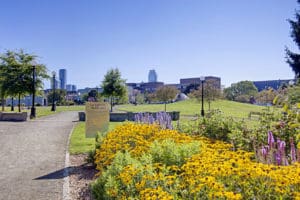
Cal Anderson Park sits near the center of modern Capitol Hill life.
It is a park, a gathering place, a shortcut, a protest site, a hangout spot, and one of the neighborhood’s most important public spaces. It is named for Cal Anderson, Washington’s first openly gay state legislator.
That name matters.
Capitol Hill’s history is not only about buildings. It is about who was allowed to be visible, who fought to belong, and who made space for the next generation.
Cal Anderson Park carries a lot of that meaning. On a sunny day, it can feel casual and joyful. During protests or community events, it can feel like Seattle’s civic living room. During harder moments, it has also reflected the city’s struggles around safety, public space, housing, addiction, policing, and inequality.
That complexity is Capitol Hill.
The neighborhood rarely gives you a simple story.
Music, Grunge, and the Counterculture Years
Capitol Hill has always made room for the weirdos, artists, night owls, musicians, writers, performers, and people who did not quite fit into Seattle’s more buttoned-up spaces.
That became especially visible during the grunge and alternative music era.
The Hill had the cheap apartments, bars, late-night food, record stores, and hangout spots that help culture happen before anyone packages it. It was not always glamorous. That was the point.
Places like Linda’s Tavern became part of Seattle music lore. Venues around Capitol Hill and nearby neighborhoods gave the city’s bands, artists, and misfits room to gather.
The tension, of course, is that culture often makes a neighborhood desirable, and desirability makes it expensive.
That story has played out again and again on Capitol Hill.
Artists and queer community helped give the neighborhood its edge. Then restaurants, nightlife, tech money, new apartments, and rising land values changed the economics underneath it. The result is a neighborhood that still has creative energy, but also constant anxiety about what is being lost.
That tension is part of Capitol Hill’s modern identity.
Capitol Hill as a Place of Protest
Capitol Hill has long been one of Seattle’s most politically expressive neighborhoods.
Its density, younger population, LGBTQ+ history, renter population, nightlife, arts culture, and proximity to downtown have made it a natural stage for marches, rallies, and public protest.
The neighborhood has been part of movements for queer rights, anti-war activism, labor issues, racial justice, tenant rights, and police accountability.
In 2020, Capitol Hill became the center of national attention during the George Floyd protests and the creation of the Capitol Hill Occupied Protest, also known as CHOP or CHAZ.
For several weeks, the area around Cal Anderson Park and the East Precinct became a temporary protest zone, mutual aid site, political symbol, art space, and flashpoint. People still debate what CHOP meant, what it accomplished, what it exposed, and how it should be remembered.
But one thing is clear.
CHOP did not come out of nowhere. Capitol Hill had already been a place where Seattle gathered to argue, mourn, celebrate, organize, and demand change.
The events of 2020 became part of a much longer neighborhood pattern.
Light Rail, Density, and the New Capitol Hill
The opening of the Capitol Hill Link light rail station in 2016 changed the neighborhood in a major way.
Capitol Hill was already dense, walkable, and central. Light rail made it even more connected.
Suddenly, the Hill had a direct rail connection to the University of Washington, downtown, the airport, and other parts of the region. That changed how people moved through the neighborhood and increased pressure for more housing near the station.
The blocks around Broadway and John became a focal point for transit-oriented development.
New apartment buildings, public plazas, retail spaces, and pedestrian activity reshaped the area around the station. For some people, that development added badly needed housing and made Capitol Hill more useful for car-free living. For others, it felt like another wave of change in a neighborhood already struggling with affordability and displacement.
Both feelings can be true.
Modern Capitol Hill is one of Seattle’s clearest examples of the city’s central housing debate. How do you add homes where people want to live without flattening the history, culture, and small-scale weirdness that made the neighborhood special in the first place?
That question shows up on almost every block.
What Capitol Hill’s History Means for Real Estate Today
Capitol Hill real estate makes more sense when you understand the history.
The grand homes near Volunteer Park and Millionaire’s Row reflect the neighborhood’s early prestige. The brick co-ops and Anhalt-style apartments reflect a more elegant era of urban apartment living. The Pike/Pine condos and mixed-use buildings reflect the transformation of old commercial and auto-row spaces. The newer apartments near light rail reflect Seattle’s push toward density and transit-oriented housing.
That is why Capitol Hill buyers often need to think beyond square footage.
A home here may come with historic charm, walkability, nightlife, transit, old-building quirks, HOA details, parking tradeoffs, noise considerations, views, architectural character, or a hyper-specific block-by-block feel.
A condo near Pike/Pine is a very different lifestyle than a co-op near Volunteer Park.
A townhouse near 12th feels different from a classic apartment near 15th.
A single-family home in North Capitol Hill is not the same thing as a modern unit near Broadway Station.
Capitol Hill is not one market. It is several micro-markets stacked on top of each other, all shaped by the neighborhood’s history.
That is why local experience matters so much here.
Why People Still Love Capitol Hill
Capitol Hill is not the easiest neighborhood in Seattle.
It is busy. It can be loud. Parking can be annoying. Prices can be intense. Some blocks feel polished, while others still feel rough around the edges. The neighborhood changes constantly, and not everyone agrees about whether those changes are good.
And yet people love it fiercely.
They love the old houses. The parks. The bars. The bookstores. The queer history. The restaurants. The sidewalks. The people-watching. The music. The old brick buildings. The fact that you can walk out your door and feel like something is happening.
Capitol Hill has never been just pretty.
It is alive.
That is the real history of the neighborhood. Every era left something behind, and somehow all of it is still in conversation: the mansions, the churches, the auto row buildings, the gay bars, the protest posters, the light rail station, the condos, the old trees, the new cranes, the drag shows, the coffee shops, and the quiet residential streets that surprise people who only know the Hill after dark.
Capitol Hill is Seattle turned all the way up.
And that is why its history still matters.
Frequently Asked Questions About Capitol Hill Seattle History
Why is it called Capitol Hill Seattle?
Capitol Hill was named by developer James A. Moore in the early 1900s. One story says he hoped the Washington State Capitol might move from Olympia to Seattle. Another says he named it after Capitol Hill in Denver, where his wife was from. Both stories are commonly repeated, and both likely influenced the name.
What was Capitol Hill called before Capitol Hill?
Before the Capitol Hill name became common, the area was often called Broadway Hill. Broadway was already one of the neighborhood’s most important streets, and it remains a central part of Capitol Hill today.
What is Millionaire’s Row in Capitol Hill?
Millionaire’s Row refers to the grand historic homes near 14th Avenue East, close to Volunteer Park. In the early 1900s, wealthy Seattle residents built large homes there, making it one of the city’s most prestigious residential areas.
Why is Capitol Hill known as Seattle’s LGBTQ+ neighborhood?
Capitol Hill became Seattle’s LGBTQ+ center as queer community life shifted from Pioneer Square and downtown toward the Hill in the 1960s and 1970s. Bars, community organizations, housing, activism, and Pride events helped make Capitol Hill the symbolic heart of LGBTQ+ Seattle.
What was Pike/Pine before it became a nightlife district?
Pike/Pine was once Seattle’s Auto Row. In the early 20th century, the area had car dealerships, garages, showrooms, and auto-related businesses. Many of the older brick and concrete buildings from that era still shape the corridor today.
When did Capitol Hill light rail open?
The Capitol Hill Link light rail station opened in 2016. It made the neighborhood even more connected and helped drive new housing, retail, and public space development around Broadway and John.
Is Capitol Hill still a historic neighborhood?
Yes. Capitol Hill has historic homes, apartment buildings, parks, institutional buildings, and commercial corridors that reflect many different eras of Seattle history. It is also a living neighborhood, which means preservation and new development often exist side by side.
How does Capitol Hill’s history affect buying a home there?
The history affects the housing stock, street feel, building types, noise patterns, walkability, parking, and neighborhood micro-markets. Buyers should pay close attention to the specific block, building history, HOA or co-op structure, transit access, and lifestyle fit.
Everything you need to know about living on Capitol Hill:
- Capitol Hill Neighborhood Page >
- Your Detailed Capitol Hill Neighborhood Guide >
- Everything You Need To Know About Buying A Condo On Capitol Hill >
- Details About Buying a Home On Capitol Hill >
- Is Buying On Capitol Hill Worth The Price >
- Who Is The Best Real Estate Agent In Capitol Hill >
- Alejandro and Ryan’s Capitol Hill Home Buying Journey >
- A Few Of The Many LGBTQ+ Neighborhoods In Seattle (Capitol Hill)>
- Best Transit Neighborhoods In Seattle Hill (Capitol Hill) >
Kim has a very unique perspective in the Capitol Hill real estate market. She has lived, worked, and played on Capitol Hill for over 25 years. She has also been recognized nationally for her innovation and activism. Are you looking for a Diva’s perspective on Capitol Hill Seattle’s real estate?
Call Kim directly at 206-850-3102 or send her an email at kim@teamdivarealestate.com to chat!